dshfsgbdkfhsdkjfsdkjlf
date
-
modality
In person
description
fdfsdfsdfsdgfsdfgsd
activity type
lecture room



fdfsdfsdfsdgfsdfgsd
Cuarto seminario de la Red de investigación temática de Procesos Estocásticos y sus Aplicaciones (RED2022-134435-T) con doble temática, correspondiente a la investigación de los nodos UGr-Prob y UGr-IO. A lo largo del mes de marzo, se desarrollarán seminarios en torno a procesos y campos aleatorios de recuento y difusión, así como algoritmos para la toma de decisiones en áreas como fiabilidad, supervivencia y medioambiente.
El evento tendrá lugar en el Instituto de Matemáticas de la Universidad de Granada desde el 06/03/2025 hasta el 28/03/2025. Los seminarios concretos se anunciarán en el calendario de la web del IMAG https://imag.ugr.es/es/calendar-2/.
Para más información, consultar la página web:
Cuarto seminario de la Red de investigación temática de Procesos Estocásticos y sus Aplicaciones (RED2022-134435-T) con doble temática, correspondiente a la investigación de los nodos UGr-Prob y UGr-IO. A lo largo del mes de marzo, se desarrollarán seminarios en torno a procesos y campos aleatorios de recuento y difusión, así como algoritmos para la toma de decisiones en áreas como fiabilidad, supervivencia y medioambiente.
El evento tendrá lugar en el Instituto de Matemáticas de la Universidad de Granada desde el 06/03/2025 hasta el 28/03/2025. Los seminarios concretos se anunciarán en el calendario de la web del IMAG https://imag.ugr.es/es/calendar-2/.
Para más información, consultar la página web:
Active matter systems consist of large collections of self-propelled particles and arise in a wide range of biological and physical contexts, including bird flocks, fish schools, and bacterial suspensions. Unlike passive systems, such particles can exhibit phase separation even in the absence of attractive interactions.
In this talk, the speaker will introduce stochastic particle models for active matter, focusing on systems of interacting active Brownian particles subject to purely repulsive forces. Then, the speaker will discuss several approaches to derive macroscopic descriptions as partial differential equations. Finally, the speaker will present results on the stability and analytical properties of one such macroscopic model.
Abstract: There has been a dramatic increase in the use of AI within mathematical research recently and it seems very likely that this trend will continue. In this talk, I will share some personal reflections on what we have seen so far and the changes that this will bring to our community and culture moving forward.
Ponente: Arnold de la Peña Cuao (Departamento de Estadística e I.O. Universidad de Granada).
Título: Modelización y análisis de variables de tipo económico mediante procesos de difusión. El caso de Colombia.
Abstract: El modelado de variables económicas dinámicas es un área de investigación en constante evolución que abarca diversos temas económicos. Este estudio modela el índice de consumo (IPC) básico en Colombia utilizando el proceso de difusión log-normal no homogéneo con factores exógenos lineales. La metodología combina un procedimiento bayesiano para la selección de factores exógenos que identificó cinco variables clave, con la estimación por máxima verosimilitud de los parámetros del modelo que permiten la obtención de expresionesanalíticas para las características principales del proceso y lafunción de densidad de probabilidad del estimador de la mediacondicional. Los resultados muestran que el modelo supera lasproyecciones del Banco Central en múltiples horizontes temporales,capturando el repunte inflacionario post-pandemia y post-invasión aUcrania de 2022. El análisis de escenarios revela que las tasas deinterés y la política monetaria son los principales factores queinfluyen en el IPC, seguidos por el sector externo y el mercado laboral.Este enfoque representa un avance significativo para economíasemergentes susceptibles a choques internos y externos, proporcionandoherramientas analíticas robustas para la toma de decisiones de política monetaria.
Ponente: Sabina Musto (Departamento de Matemáticas, Università degli Studi di Salerno).
Título: From Growth to Collapse: Modeling Population Dynamics via Lognormal diffusions processes with random catastrophes.
Fecha y hora: 22 de mayo de 2026, 11:30.
Abstract: Stochastic growth models and sigmoidal dynamics are essentialtools for describing patterns that frequently arise in natural systems. They are widely used in biology and ecology to represent mechanisms suchas population development, disease spread, and adaptive responses toenvironmental fluctuations. In this work, we investigate a lognormaldiffusion process subject to random catastrophic events, modeled assudden jumps that reset the system to a new random state. The novelty ofthe model lies in the assumption that the post-catastrophe restart levelfollows a binomial distribution. As a consequence, after eachcatastrophic event the population does not simply revert to its initialsize, but instead to a random level reflecting the survival probabilityof individual members. We apply this framework to the dynamics of a wolf population exposed to external disturbances. The findings show that themodel can realistically reproduce complex population trajectories, displaying periods of gradual growth interspersed with sudden declines triggered by unpredictable external shocks.
Title: Fractional hyperbolic diffusions on sphere with random data.
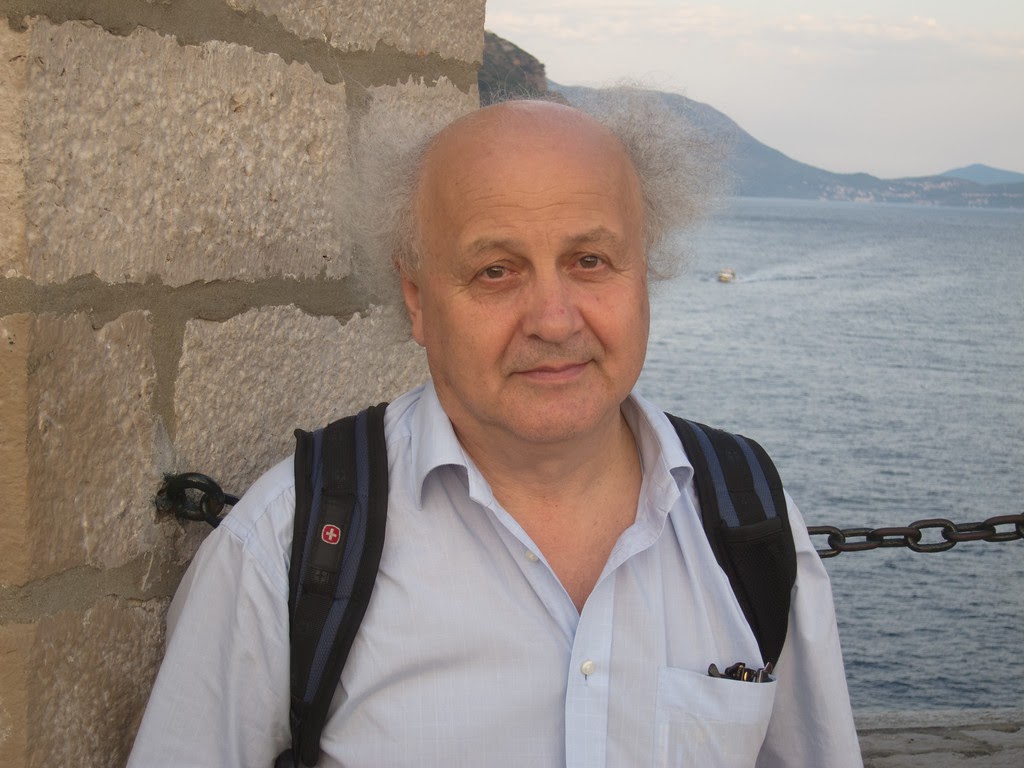
Speaker: Nikolai Leonenko
(Cardiff School of Mathematics, Cardiff University).
| 9:30-11:00 | Part I |
| 11:00-11:30 | Coffee break |
| 11:30-13:00 | Part II |
Part I. Introduction to statistical analysis of Gaussian isotropic spherical random fields.
Spherical random fields are very useful for modelling some phenomena in areas such as earth sciences (like, for example, in geophysics and climatology and cosmology). In fact, the application of statistical methods in cosmology has become increasingly important due to the many experimental data obtained in recent years, and spherical random fields are of particular interest regarding the analysis of Cosmic Microwave Background (CMB) radiation discovered by the astronomers Arno Penzias and Robert Wilson in 1964.
As well-known, the CMB is a spatially isotropic radiation field spread throughout the visible universe, originated around 14 billion years ago, and it is the main source of information we have about the evolution of the universe. The CMB radiation can be mathematically modelled as an isotropic spherical random field for which there is a spectral representation by means of spherical harmonics.
We consider statistical analysis of Gaussian isotropic spherical random fields, when only one observation of the field is available. The characteristic function of these empirical covariances is given in terms of cumulants. It turns out that our estimator follows a Rosenblatt type distribution [1,2,3]. Our goal is to estimate the covariance function of the random field, given a single observation at each point of the discretized sphere. We present a methodology for handling the problem of cosmic variance in this framework.
This is joint results with M.Taqqu (Boston University, USA) and G.Terdik (Debrecen University, Hungary). Some results used in the talk are obtained jointly with M.D.Ruiz-Medina (Granada University, Spain).
Part II. Fractional hyperbolic diffusions on sphere with random data.
Our next objective is to study the fundamental solutions to fractional hyperbolic diffusion equation in the time variable using the Caputo derivative, and its properties. The exact solutions of the fractional hyperbolic diffusion equation with random data are derived in terms of series expansions of isotropic in space random fields on the unit sphere. The results are illustrated through motivating numerical examples of interest in several applied fields.
This is joint results with A. Olenko (La Trope University, Melbourne, Australia) and J.Vaz (UNICAMP, Brazil) [4,5].
References:
For more information, visit:
Title: Stochastic processes in software reliability.
Speaker: Tadashi Dohi (Department of Engineering, Hiroshima University).
 Dr. Tadashi Dohi has served as a Full Professor at Hiroshima University, Japan, since 2002. He is currently appointed as Dean of School of Informatics and Data Science and Associate Dean of Graduate School of Advanced Science and Engineering, Hiroshima University. He received a Doctor of Engineering degree from Hiroshima University in 1995. His research interests include Software Reliability, Dependable Computing, Performance Evaluation, and Operations Research.
To date, his research has led to 280 journal papers, 340 peer-reviewed conference papers, 25 book editions, and 47 book chapters in the above research fields. Dr. Dohi is a Regular Member of IEICE, IPSJ, REAJ, a Fellow Member of ORSJ, and a Senior Member of IEEE (Computer Society and Reliability Society). He was acting President of REAJ in 2018 and 2019. He has served as the General Chair of 15 international conferences, including ISSRE 2011, ATC 2012, DASC 2019, and ICECCS 2022. Of note, he was a founding member of the Internationa Symposium on Advanced Reliability and Maintenance Modeling (APARM) and International Workshop on Software Aging and Rejuvenation (WoSAR). He has been a steering committee member in AIWARM/APARM, ISSRE, DASC, DSA. He has also worked as a program committee member in several premier international conferences such as DSN, ISSRE, COMPSAC, SRDS, QRS, EDCC, PRDC, HASE, SAC, ICPE, among numerous others. He is an Associate Editor/Editorial Board Member of over 20 international journals, including IEEE Transactions on Reliability.
Schedule: 9:30-11:00h & 11:30-13:00h.
Software reliability engineering plays a central role to quantify software product reliability in the verification/validation phase before the release. During the last five decades, in fact, over two hundred software reliability models have been proposed in the literature. First, we quickly overview the software reliability modeling based on the software fault count data observed in the testing phase, where homogeneous Markov processes (HMPs) and non-homogeneous Poisson processes (NHPPs) have gained much popularity to assess quantitative software reliability. Next, we provide generalization frameworks on software reliability models, by introducing non-homogeneous Markov processes (NHMPs). Finally, we give some examples on non-Markovian process modeling, including geometric processes, trend renewal processes (TRPs) and Hawkes processes. We show how these generalized software reliability models can work better than the classical ones in terms of goodness-of-fit and predictive performances, through several empirical studies with actual software fault count data.
For more information, visit: